|
In 1897, ten seniors at the University of Maine,
envisioning a society whose membership would be open to the superior college student
regardless of the academic discipline, were helped by interested professors to organize
the Lamda Eta Sigma Society. A year or so later, the name was changed to the Morrill
Society, in honor of the sponsor of the Congressional Act, which provided for land-grant
colleges. In 1900, the presidents of the University of Maine, the Pennsylvania State
College (now Pennsylvania State University), and the University of Tennessee pledged their
support; the Society thus became national, with three chapters. It was renamed Phi Kappa
Phi, from the initial letters of the three Greek words forming its adopted motto
"philosophia krateito photon" (filo-so-FEE-uh Krah-TAY-toe foe-TONE) or "Let
the love of learning rule humanity."
Currently, there are
nearly 300 chapters of Phi Kappa Phi
scattered from Maine to Hawaii and the Philippines, and from the state of Alaska to Puerto
Rico. Over 1,000,000 scholars have been initiated into the Society, which is now in its
108th year.
Adapted from
PKP Promotional Materials |
|
 By its
75th year, Phi Kappa Phi had chartered 142 chapters on campuses around the
nation. Youngstown State University became the 143rd campus to receive a
charter, and the installation of the YSU chapter was held on May 19, 1972.
Twenty-one professors and administrators became the charter members of Chapter
143. Six of them, including John Cernica from Civil Engineering, Clyde Hankey
from English, YSU Vice-President Earl Edgar, and YSU President Albert Pugsley,
were already members of Phi Kappa Phi, having been inducted previously. By its
75th year, Phi Kappa Phi had chartered 142 chapters on campuses around the
nation. Youngstown State University became the 143rd campus to receive a
charter, and the installation of the YSU chapter was held on May 19, 1972.
Twenty-one professors and administrators became the charter members of Chapter
143. Six of them, including John Cernica from Civil Engineering, Clyde Hankey
from English, YSU Vice-President Earl Edgar, and YSU President Albert Pugsley,
were already members of Phi Kappa Phi, having been inducted previously.
YSU's
first Phi Kappa Phi convocation was held in Schwebel Auditorium. Earl Edgar,
YSU’s vice-president for academic affairs and the first president of the new
chapter, welcomed the guests and new initiates. The installation ceremonies were
conducted by Dr. John McDow of the University of Tennessee, PKP’s vice-president
for the East Central Region (and later national president from 1980 to 1983).
Dr. Pugsley gave the address, and the new chapter officers handled the
initiation of ten graduate and sixty-one undergraduate student members. Dr.
Howard Jones, who served as YSU’s first president from 1931 to 1966, was named
an honorary member. Larry Esterly, a faculty member in Political Science,
served as a marshal for the ceremony. Phi Kappa Phi’s national president, Dr.
Albertine Krohn of the University of Toledo, gave the closing remarks, and the
group adjourned to the Kilcawley Faculty Lounge for a reception.
Since that first
initiation ceremony, Chapter 143 has inducted approximately 2,600 members, and
twenty-nine faculty members have served as president of the chapter. On May 19,
1997, Chapter 143 celebrated its 25th anniversary and planted a commemorative
tree to mark the occasion. The tree, located on the YSU campus by the sidewalk
southeast of DeBartolo Hall, is a living tribute to those founding members who
brought Phi Kappa Phi to our campus.
Adapted from
a Newsletter Article by Chapter 143 Historian Rick
Shale |
|
The badge
of this Society is a globe against the background
of the sun, whose rays form an expansive corona and radiate in eight
symmetrical concentrations from behind the globe. These
signify equivalence among the various branches of learning and
represent the dissemination of truth as light.
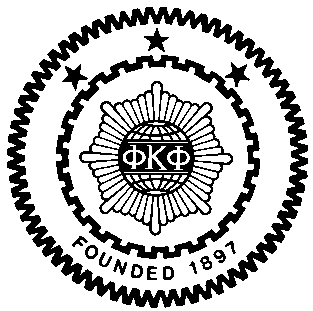 Encircling
the globe is a band containing the Greek letters for Phi Kappa Phi and
symbolizing a fraternal bond, which girds the earth and binds the lovers of
wisdom in a common purpose. Encircling
the globe is a band containing the Greek letters for Phi Kappa Phi and
symbolizing a fraternal bond, which girds the earth and binds the lovers of
wisdom in a common purpose.
The
ribbon of The Society, bearing at one end the letters
PKP (Phi Kappa Phi) is
a meander pattern that is common in ancient Greek art and that thus symbolizes
the classical features of The Society. The seal of The Society has at its
center the Badge. This in turn is surrounded by a crenellated line representing the battlements and walls of Troy and symbolizing the
technological aspects of the ancient Greek culture reflected by The
Society. In the space between this line and the periphery of the seal
appear three stars just above the badge, one for each of the three original
Chapters. Just below the badge is the phrase "Founded 1897."
|